Open: 10am - 4pm, Tuesday - Saturday

  • Buy Tickets
  • Visit Us
  • Support Us
  • Subscribe to Yanks!
  • HOME
  • COLLECTIONS
    • Collection By Timeline
    • 1903-1918 / Early Birds
    • 1919-1938 / Golden Era
    • 1939-1945 / World War II
    • 1946-1975 / Jet Age
    • 1976-Present / Modern Jets
    • Drones & Missiles
    • Vehicles & Equipment
    • Specialty
  • ABOUT
    • Our History
    • Flight Team
    • Featured News
    • Preservation & Restoration
  • EVENTS
  • BOOK VENUE
  • GIFT SHOP

Open: 10am - 4pm, Tuesday - Saturday

  • Buy Tickets
  • Visit Us
  • Support Us
  • Subscribe to Yanks!
  • HOME
  • COLLECTIONS
    • Collection By Timeline
    • 1903-1918 / Early Birds
    • 1919-1938 / Golden Era
    • 1939-1945 / World War II
    • 1946-1975 / Jet Age
    • 1976-Present / Modern Jets
    • Drones & Missiles
    • Vehicles & Equipment
    • Specialty
  • ABOUT
    • Our History
    • Flight Team
    • Featured News
    • Preservation & Restoration
  • EVENTS
  • BOOK VENUE
  • GIFT SHOP
Yanks Air Museum
Yanks Air Museum
3 events found.

Events Search and Views Navigation

Event Views Navigation

  • List
  • Month
  • Day

Events

Today
  • April 2026

  • Sat 11
    Easter at Yanks Air April 11, 2026

    EASTER CELEBRATION & Eggs-citing Egg-Hunt!

    Featured Saturday, April 11 @ 1:00 pm - 3:00 pm
    Yanks Air Museum 15121 Stearman Drive, Chino, United States

    TICKETS FOR 2026 EVENT WILL BE POSTED CLOSER TO THE EVENT DATE Looking for...

  • October 2026

  • Sat 24
    Halloween Hangar Trick or Treat event at Yanks Air Museum

    HAUNTED HANGAR TRICK OR TREAT at YANKS!

    Featured Saturday, October 24 @ 1:00 pm - 3:00 pm
    Yanks Air Museum 15121 Stearman Drive, Chino, United States

    TICKETS FOR 2026 WILL BE POSTED CLOSER TO THE EVENT DATE Join us for...

  • November 2026

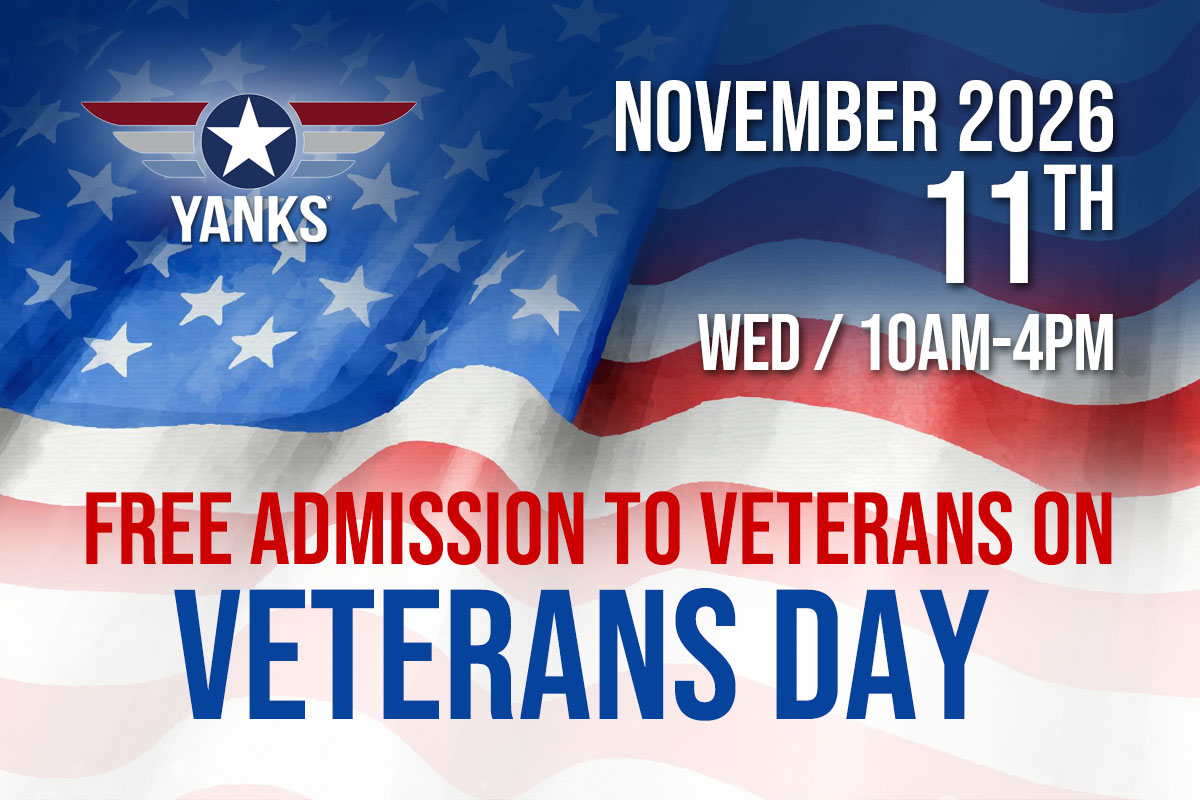
  • Wed 11
    Veterans Day - FREE Admission to Veterans

    VETERANS DAY – Free Admission to Veterans

    Featured Wednesday, November 11 @ 10:00 am - 4:00 pm
    Yanks Air Museum 15121 Stearman Drive, Chino, United States

    For one day, we stand united in respect to veterans. FREE Admission to Veterans...

  • Today
  • Google Calendar
  • iCalendar
  • Outlook 365
  • Outlook Live
  • Export .ics file
  • Export Outlook .ics file
Stay in Touch

Join our email list and be the first to know about special events and more!

Yesterday's "Pardo's Push" story showcased the ing Yesterday's "Pardo's Push" story showcased the ingenuity of F-4 crews in Vietnam. Today, meet the McDonnell F-4 Phantom II itself, the Cold War's most versatile combat jet, serving as fleet interceptor, fighter-bomber, and reconnaissance platform for the U.S. Navy, Air Force, and allies.
​
Between 1959 and 1962, Phantoms set 16 world records for speed, altitude, and climb, including an absolute speed mark of 1,606 mph that stood until the F-15. In Vietnam. U.S. Phantoms downed over 150 MiGs (USAF ~100, USN ~50), though at high cost from SAMs and AAA. Its payload, up to 18,000 pounds of ordnance, rivaled WWII bombers like the B-17, enabling massive flexibility across air-to-air and strike missions. Pioneering electronics like APQ-120 radar and Combat Tree IFF made it a testbed for modern avionics. In the late 1970s, Navy F-4Js received the F-4S upgrade: smokeless J79-GE-10B engines (eliminating the telltale black plume), slats for better low-speed handling, a strengthened airframe, and updated wiring/plumbing/avionics, extending service into the 1980s.

5,195 Phantoms were built (5,057 in the U.S., 138 licensed in Japan by Mitsubishi), serving in U.S. front-line units until 1986 when the F-14 Tomcat and F/A-18 Hornet took over, while hundreds continued flying with allies worldwide for decades more.

This F-4S joined our collection in 2001. We don't have any information on its service history.
On March 10, 1967, over North Vietnam, two U.S. Ai On March 10, 1967, over North Vietnam, two U.S. Air Force F-4C Phantom IIs of the 8th Tactical Fighter Wing were in serious trouble. What followed became one of the most remarkable displays of airmanship and courage in aviation history, remembered as “Pardo’s Push.”

Maj. John R. “Bob” Pardo and 1st Lt. Stephen A. Wayne had just struck the heavily defended Thai Nguyen Steel Works, one of North Vietnam’s key industrial targets. Both their Phantom and the wingman’s jet, flown by Capt. Earl Aman and Lt. Robert Houghton, were hit by intense antiaircraft fire, and Aman’s F-4 was losing fuel so rapidly there was no chance of reaching a base in Thailand.

Pardo could not accept watching his comrades eject over North Vietnam and face almost certain capture. Thinking fast, he came up with an almost unthinkable solution: use his own aircraft to push Aman’s crippled Phantom far enough for the crew to bail out over friendlier territory.

He first tried to push against the drag chute compartment at the tail of Aman’s aircraft, but the airflow and turbulence made it impossible to hold contact. Pardo then had Aman lower the F-4’s tailhook, and with careful flying he eased the nose of his Phantom up under the hook and began literally pushing the other jet forward while both aircraft descended and dealt with battle damage.

For roughly 80 miles, Pardo used this improvised “tow bar in the sky” to nurse Aman’s aircraft toward Laotian airspace, even shutting down and restarting an engine along the way. When both Phantoms were nearly out of fuel, the crews ejected over Laos, evaded capture, and were rescued, all four airmen surviving a mission that could easily have ended in loss and imprisonment.

Pardo was initially reprimanded for losing his aircraft, because regulations stressed preserving jets whenever possible. Years later, the Air Force reviewed the mission and awarded both John R. Pardo and Stephen A. Wayne the Silver Star, recognizing an extraordinary example of loyalty, ingenuity, and calculated courage in combat.
The Convair/General Dynamics VC-131F Samaritan was The Convair/General Dynamics VC-131F Samaritan was the U.S. military's dedicated medical airlift platform, a militarized version of the Convair CV-240/340/440 family of commercial airliners. Featuring a strengthened fuselage floor, large cargo doors, and over 20 litter stations accommodating many medical patients plus attendants, it provided critical battlefield evacuation and VIP medical transport from 1957 through the mid-1970s.

Powered by two Pratt & Whitney R-2800 Double Wasp radial piston engines driving Hamilton Standard four-blade propellers, the VC-131F offered reliable short-field performance with 4,000 shaft horsepower. Its pressurized cabin—derived from the Convair 240/340 airliner—allowed the aircraft to transport passengers or medical patients comfortably at higher altitudes.

The Samaritan logged thousands of hours evacuating wounded from Vietnam and transporting patients between military airfields and medical facilities, often operating from forward airstrips under combat conditions. More than just a transport, it represented the Air Force's commitment to rapid casualty care, saving countless lives by bridging the gap between battlefield and hospital. 

Our aircraft was delivered on January 3, 1956, and initially assigned to BAR San Diego, California, where it served until 1960 before transferring to BAR Columbus, Ohio. In January 1961, it underwent conversion to VC-131F configuration at NAS Anacostia. From May 1962 until 1982, it operated out of NAF Andrews in Washington, D.C., including service as a Late 340/440 Admiral’s aircraft and as transportation for the Commander of the Naval Reserve, accumulating 12,322 flight hours. It was retired to MASDC at Davis-Monthan AFB, Arizona, on August 18, 1982, before joining our collection in June 2004 and arriving at the museum on October 26, 2004.

📸 @paddybphotography
On March 7th 1945 the PV-3 prototype tandem helico On March 7th 1945 the PV-3 prototype tandem helicopter completed its first flight. The PV-3 was the first successful tandem-rotor helicopter and paved the way for other aircraft such as the Piasecki CH-21B Workhorse and the Boeing CH-47F Chinook.

Pictured is the PV-3 on its first flight, a CH-21B Workhorse, and a Boeing CH-47 Chinook.
In 1963, the U.S. Navy began searching for a repla In 1963, the U.S. Navy began searching for a replacement for the A-4 Skyhawk. Speed of development was critical, so Chance Vought proposed a simplified, more rugged derivative of its successful F-8 Crusader. The result was the A-7 Corsair II, an aircraft designed for range, payload, and precision rather than raw speed.

Though less complex than the F-8, the A-7 represented a major leap forward in strike capability. It could carry nearly every offensive weapon in the Navy’s inventory and deliver it accurately over long distances. Entering service during the height of the Vietnam War, the Corsair II quickly proved itself as a dependable and effective bombing platform. Its performance and versatility even led to adoption by the U.S. Air Force.

Affectionately nicknamed the “Short Little Ugly Fella,” the A-7 earned the respect of the crews who flew and maintained it.

Our A-7B, Bureau Number 154475, was delivered in January 1971 and assigned to VA-46 at NAS Cecil Field, deploying aboard the USS John F. Kennedy. It later served with VA-203 at NAS Jacksonville beginning in September 1977 and with VA-205 in Atlanta in July 1983. In June 1984, it was retired to storage at MASDC, Davis-Monthan AFB, Arizona.

📸 @paddybphotography
On March 5th 1936, Vickers-Supermarine’s Chief Tes On March 5th 1936, Vickers-Supermarine’s Chief Test Pilot, Captain Joseph “Mutt” Summers, lifted the prototype Type 300 into the air from Eastleigh Aerodrome at Southampton. The flight lasted only eight minutes, but it confirmed that Reginald J. Mitchell’s sleek new fighter possessed exceptional promise. Summers is widely credited with remarking afterward, “Don’t change a thing,” a concise endorsement of what would soon become the Supermarine Spitfire.

The Type 300 had been developed as a private venture to satisfy an Air Ministry requirement for a modern, high-speed monoplane interceptor. Drawing on Mitchell’s experience designing the Schneider Trophy–winning racing seaplanes, the aircraft featured a slim fuselage and distinctive elliptical wings that reduced drag while preserving structural strength. Powered on its first flights by an experimental Rolls-Royce Merlin C V-12 engine driving a two-bladed wooden propeller, the prototype demonstrated impressive speed and climb performance. Subsequent refinements, including improved exhaust arrangements, yielded additional thrust and higher top speeds.

Flight testing showed the aircraft to be stable, responsive, and well suited as a gun platform. Although K5054 suffered damage in later accidents and was ultimately lost in 1939, the Air Ministry had already ordered the Spitfire into production before the prototype ever flew. More than 20,000 examples would be built in numerous variants, and the Spitfire would become one of the most iconic and effective fighters of the Second World War. Summers himself went on to make the maiden flights of dozens of significant British aircraft, securing his place among the leading test pilots of his era.

Yanks Air Museum

VISITOR INFORMATION
  • BUY TICKETS ONLINE
  • BUY ANNUAL PASS
  • VISIT US
  • SCHEDULE A TOUR
  • CONTACT US
  • SUBSCRIBE TO YANKS!
EXPLORE OUR MUSEUM
  • COLLECTIONS
  • EVENTS
  • FEATURED NEWS
  • SUPPORT US
  • ONLINE GIFT STORE
LOCATION & HOURS

15121 Stearman Drive
Chino, CA 91710

Phone: (909) 597-1735

Open Tuesday thru Saturday
10:00 a.m. to 4:00 p.m.

Closed Sunday and Monday
Closed Major Holidays

© 2022-2025 Yanks Air Museum. All rights reserved. EIN 953538758  /  Site Map  /  Privacy Policy  /  Terms & Conditions

Press Enter / Return to begin your search.

Have an Account?

To keep connected with us please login with your personal info.

Sign In

Create Account

Enter your personal details and start journey with us.

Sign Up

Sign in to Yanks Air Museum

  • Lost Your Password?

Create Account

New membership are not allowed.

  • Home
  • Collections
    • Collection by Timeline
    • 1903-1918 / Early Birds
    • 1919-1938 / Golden Era
    • 1939-1945 / World War II
    • 1946-1975 / Jet Age
    • 1975-Present / Modern Jets
    • Drones & Missiles
    • Vehicles & Equipment
    • Specialty
  • About
    • Our History
    • Flight Team
    • Featured News
    • Preservation & Restoration
  • Events
  • Book Venue
  • Gift Shop
Museum Hours

10:00am–4:00pm, Tuesday thru Saturday

Museum Location

15121 Stearman Drive, Chino, CA 91710

Buy Tickets
Visit Us
Support Us
Contact Us
Subscribe to Yanks!